Laundry
Dryer Runs but Won't Heat: 7 Causes and How to Test Them
The drum turns, the timer counts down, and the clothes come out cold and damp. Here is the order to check a dryer that tumbles without heat.
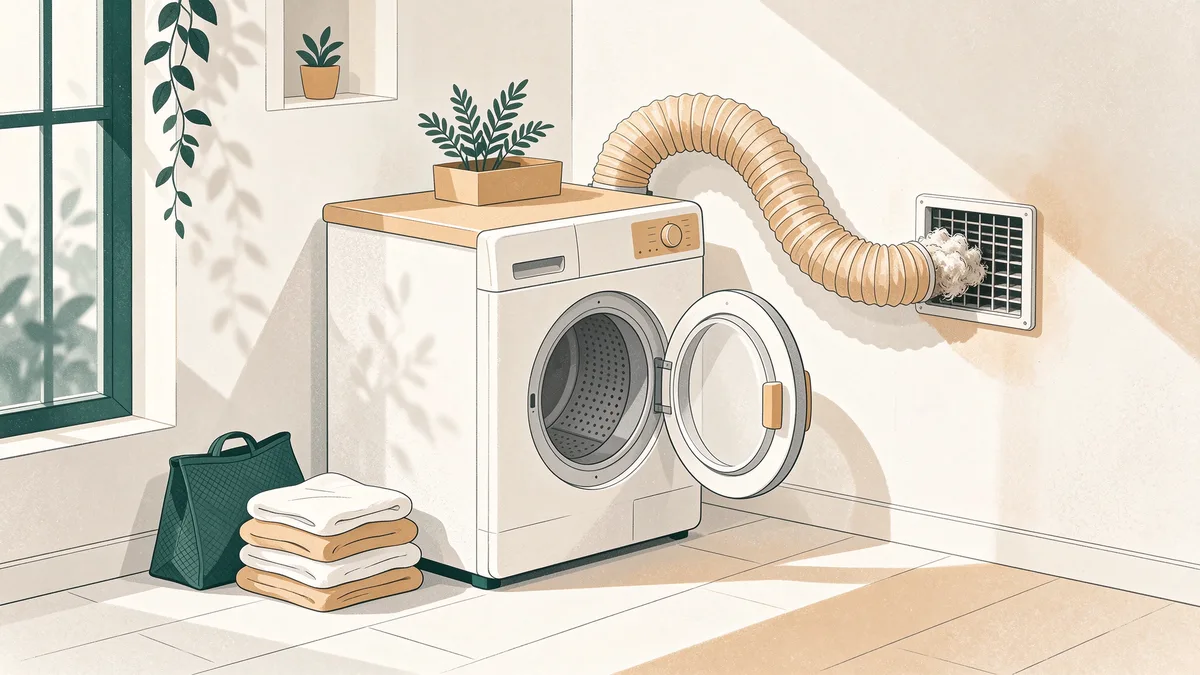
A dryer that tumbles but never warms up is one of the most common appliance failures, and it is also one of the cheapest to diagnose. The drum motor and the heat circuit are separate systems on almost every dryer built in the last forty years, so a spinning drum tells you the motor, belt, and door switch are fine. What has failed is somewhere in the chain that creates heat.
There are two families of dryer and they fail differently. Electric dryers make heat with a heating element or a set of coils. Gas dryers make heat with a burner and an igniter. Both share the same airflow path, and both share the same safety devices. The order below starts with the checks that cost nothing.
Before you touch anything
Unplug the dryer. On a gas dryer, also close the shut-off valve on the gas line behind the machine, usually a quarter-turn ball valve. Do not skip this on a gas unit even if you only plan to look at the vent.
Dryers run on 240 volts in the US and Canada, and the heating circuit is the part that draws the current. Pull the plug fully out of the receptacle rather than just flipping the breaker, so nobody restores power while your hands are inside the cabinet.
Gas dryers also have a burner assembly with a glow igniter and a flame sensor. If you smell gas at any point, stop, ventilate, and call your gas utility. Do not test for leaks with a flame.
1. The vent is clogged or the duct is crushed
This is the single most common cause, and it is free to check. A dryer needs airflow to move heat into the clothes. When the exhaust path narrows, the machine overheats, a safety device opens, and the burner or element stops getting power. Many dryers then run cool for the rest of the cycle.
How to test it: Disconnect the duct at the back of the dryer. Look inside the dryer’s exhaust outlet with a flashlight for lint buildup. Then look through the duct itself. A duct that has been pushed flat behind the machine, or one with a bird nest or a lint plug at the exterior hood, is your problem.
Also check the exterior hood. A flap that does not open freely, or a screen packed with lint, is enough to strangle airflow.
What it means: If you find a blockage, clean it out fully, reconnect everything, and run a timed cycle with a wet towel. If heat returns, you have solved it. Do not operate the dryer with the duct disconnected; that dumps moisture and lint into the room.
While you are back there: a duct that is longer than about 25 feet, has more than one 90-degree elbow, or transitions to flexible foil crushes easily. Those installations need cleaning every year.
2. The thermal fuse has blown
Almost every dryer has a thermal fuse on the exhaust side of the heat path. It is a one-shot device: when the exhaust gets too hot, the fuse opens permanently and cuts power to the heat circuit. It blows for a reason, and that reason is nearly always restricted airflow.
How to test it: With the dryer unplugged, locate the fuse on the blower housing or the exhaust duct inside the cabinet. Disconnect one lead and check continuity with a multimeter. A good fuse reads close to zero ohms. An open fuse reads nothing.
What it means: A blown fuse means the airflow problem in step 1 has to be fixed first. Replace the fuse only after the vent is clean, otherwise the new fuse will blow again within weeks.
Some dryers use a resettable thermostat next to the fuse. Those have a small button on the body. If the button clicks when pressed, the device had tripped and you can reset it.
3. The heating element has burned through
On an electric dryer, the element is a coil of resistance wire inside a metal housing. Over time it can break, and when it breaks the circuit is open. Sometimes it breaks in a way that leaves a partial coil still working, which is why some dryers heat weakly instead of not at all.
How to test it: Unplug the dryer and remove the back panel or the lower front panel, depending on the model. Disconnect the element’s two leads and measure resistance across the terminals. A healthy element reads roughly 8 to 15 ohms. An open circuit, or a reading far above that range, means replacement.
What it means: Look at the coil before you order a part. A coil that has sagged against the housing and shorted will usually show a burnt spot or a broken segment. If the element looks intact and measures open, suspect a failed wire or connector before condemning it.
4. A thermostat or high-limit switch has failed open
Electric dryers have two or three thermal devices in the heat path: an operating thermostat that cycles the element on and off, a high-limit thermostat as a backup, and sometimes the thermal fuse from step 2. Any of them can fail open and leave the element with no power.
How to test it: With power off, check continuity across each device. Most operating thermostats are normally closed and read zero ohms at room temperature. A high-limit switch should also read closed when cold.
What it means: These devices are cheap and easy to replace, but a failed high-limit switch is another symptom of airflow trouble. Fix the vent, then replace the switch.
5. The dryer is only getting half its power
Electric dryers use a 240-volt circuit delivered through two hot legs. The motor runs on 120 volts taken from one leg, and the element uses both legs. If one leg is dead at the breaker, the wall receptacle, or the cord, the dryer will tumble but never heat. This is exactly the symptom that sends people to buy a new dryer.
How to test it: With the dryer unplugged, inspect the cord and plug for scorching. Then, if you are comfortable working at the panel, check that both poles of the double breaker are on and not tripped to the middle position. A breaker that trips halfway looks on but is not.
What it means: If one leg is dead, the dryer is fine and the problem is the circuit. This is electrician work. Do not open the panel yourself unless you have done it before; the main lugs stay live even with the dryer breaker off.
6. The door switch or the belt is fooling the timer (gas dryers especially)
On gas dryers, the burner only fires when the airflow switch and the door switch both agree the machine is running. A door switch that makes intermittent contact lets the drum turn but drops the burner.
How to test it: Open and close the door several times while the dryer runs and listen for the burner to attempt ignition. Then, with power off, check continuity of the door switch in the closed position.
What it means: An intermittent door switch is a common cause of “sometimes it heats, sometimes it doesn’t.” Replace it.
7. The gas burner, igniter, or coils have failed
Gas dryers light the burner with a hot-surface igniter and hold the flame with a sensor. The gas valve itself is opened by two solenoids, often called coils, that are a known weak point.
How to test it: With the gas valve closed and the dryer unplugged, remove the burner cover. Look at the igniter: a cracked or broken igniter will not glow. If it glows but no flame appears, the coils on the gas valve are the usual suspect. Many appliance techs replace the coil pair as a set because they fail together.
What it means: Igniter and coil replacement are jobs a careful DIYer can do, but they involve working next to a gas line. If the burner does not light after an igniter and coil replacement, stop. The remaining possibilities involve the gas valve body and the supply, and that is licensed work.
Quick diagnosis table
| What you observe | Most likely cause | Effort |
|---|---|---|
| Weak or no heat, long dry times, machine hot to the touch | Clogged or crushed vent | Low, clean it |
| No heat at all after an overload or blocked vent | Blown thermal fuse | Low, plus vent cleaning |
| Element visibly broken or reads open | Heating element | Medium |
| Heats then cuts out mid-cycle | High-limit or operating thermostat | Low |
| Tumbles but never heats, breaker looks fine | Half the 240-volt circuit is dead | Electrician |
| Gas unit: igniter glows, no flame | Gas valve coils | Medium |
| Gas unit: no glow at all | Igniter or flame sensor | Medium |
When to stop and call a technician
Call a pro if the dryer is a gas unit and the burner does not light after you have replaced the igniter and coils, if you find scorched wiring or a melted connector, or if the cabinet shows signs of overheating such as discolored metal around the element.
Do not bypass a thermal fuse, a high-limit thermostat, or a door switch. Every one of those devices exists because a dryer fire is easy to start and hard to stop. If the machine keeps blowing fuses after a proper vent cleaning, the duct design itself is wrong and needs to be re-run.
If your dryer is more than fifteen years old and the drum bearing is also noisy, the repair bill can approach the price of a basic new unit. That is a judgment call, not a safety issue.
Related reading
If your machine fills but will not empty, that is a different system entirely: see washer won’t drain. For a dishwasher that leaves dishes wet, see dishwasher won’t drain.