Kitchen
Refrigerator Not Cooling but Freezer Works: 7 Checks in Order
A warm fridge with a cold freezer usually means an airflow or defrost problem, not a dead compressor. Here is how to test each cause before you call anyone.
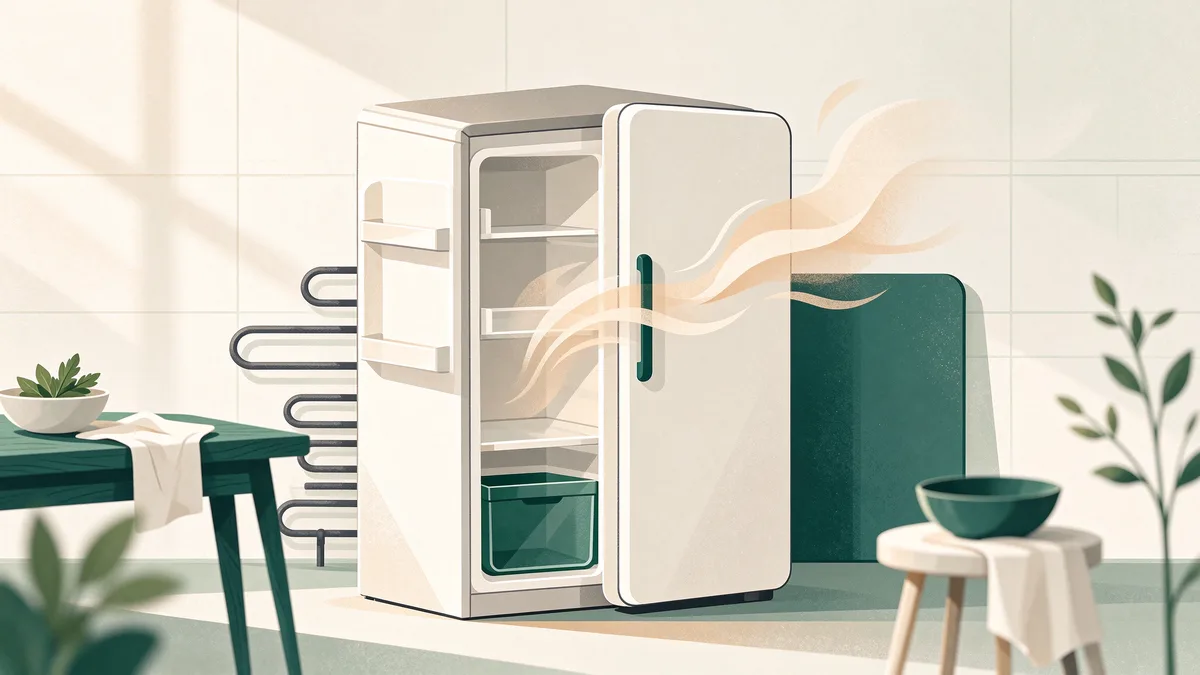
The freezer is still making ice and the fridge section is lukewarm. This split symptom is one of the most useful clues in appliance repair, because it tells you the sealed cooling system is probably working. If the compressor had failed, both compartments would be warm.
What you likely have is a fridge that is cold in the wrong place. Air is chilled in the freezer and blown into the fridge section through a duct. Anything that blocks that air, or that builds frost over the evaporator coils, breaks the loop. The first four checks below cost nothing but a screwdriver and some time.
Before you touch anything
Unplug the refrigerator before you remove any panel. There is line voltage at the evaporator fan and the defrost heater, and it is wet inside those compartments.
Give the fridge a full 24 hours before you test anything. After a power interruption or after someone left the door open, a modern fridge can take a day to pull temperatures back down, and people condemn machines that were simply warm.
Put a thermometer in the fridge and one in the freezer, in the middle of each compartment, and leave them overnight. Air temperature near the wall is several degrees colder than the middle of the shelf.
Do not chip ice with a knife or a screwdriver. Refrigerant lines run behind the liner and puncture easily. A punctured line turns a $60 repair into a $900 one.
1. The condenser coils are buried in dust
The coils are the black grid on the back, or behind a grille at the bottom on newer models. They dump heat into the room. When they are coated with dust and pet hair, the fridge cannot reject enough heat and both compartments drift warm. The freezer usually holds on longer because it has more cold capacity.
How to test it: Pull the fridge out and look at the coils. If you cannot see the fins through the lint, that is your answer. On bottom-grille models, remove the kick plate and look underneath.
What it means: Clean them with a coil brush and a vacuum, front to back, gently enough not to bend the fins. Repeat every six to twelve months. On a fridge in a house with pets, twice a year.
2. The evaporator fan is not running
Inside the freezer there is a fan that pushes cold air through the evaporator and out the duct into the fridge. When the fan motor fails, the freezer gets very cold around the coils and the fridge section starves. It is also the classic cause of a freezer that frosts up in one corner.
How to test it: Open the freezer door and press the door switch with your hand. The fan should start. If it is silent, or if it hums and does not turn, the motor or the blade is the problem. With the fridge unplugged, remove the evaporator cover inside the freezer (behind the rear panel) and check whether the blade is hitting ice or the motor shaft spins freely.
What it means: A fan motor is an inexpensive part and a genuinely DIY-able job on most models. If the fan is iced in, the defrost system in step 4 is failing and will need fixing too.
3. The air damper between freezer and fridge is stuck
The duct that carries cold air into the fridge section has a damper door controlled by a motor or a wax actuator. The control board opens it when the fridge needs cold. A stuck-closed damper produces exactly the split symptom: cold freezer, warm fridge, no error code.
How to test it: Locate the damper at the top of the fridge compartment, usually behind a plastic shroud. With the fridge running, watch whether the door moves when you change the fridge temperature setting down. If the damper never moves, either the actuator or the board signal has failed.
What it means: Test the actuator with a meter before buying a board. Actuator failures are common; board failures are less so, and the board is the expensive part.
4. The defrost system has failed and the coils are iced over
This is the most common cause of the exact symptom in the title. Every fridge runs a defrost cycle several times a day to melt frost off the evaporator. That cycle depends on a timer or the control board, a defrost heater, a bi-metal thermostat, and often a thermistor.
When any of those fail, frost builds until the evaporator is a solid block of ice. Air cannot pass, the fridge goes warm, and the freezer may still be cold because it is sitting next to that ice block.
How to test it: Unplug the fridge and remove the evaporator cover in the freezer. If you find a heavy frost pattern, or a block of ice covering the coils, defrost is the fault. To test the heater, unplug its leads and measure resistance; an open reading means a dead heater. Test the bi-metal thermostat for continuity at room temperature, where it should be open, and in ice, where it should close.
What it means: A failed heater or thermostat is a moderate repair that requires thawing the compartment, usually with a hair dryer on low and a lot of towels. Do not use a heat gun; the plastic liner warps.
5. The door seals are leaking warm air
A torn or hardened gasket lets humid room air into the fridge. That air carries moisture, which lands on the evaporator as frost, which eventually blocks airflow. So a bad gasket can produce both a warm fridge and an iced-up evaporator, which is why people replace defrost parts and the problem comes back.
How to test it: Close the door on a dollar bill at several points around the perimeter. If the bill slides out easily, the seal is not contacting. Run a bright light inside and look for light leaking around the door in a dark room.
What it means: Clean the gasket first; a syrup spill can hold the door off its seal. If the rubber is stiff or torn, replace the gasket, and check the door hinges for sag.
6. The thermistor is reading the wrong temperature
The control board decides when to run the compressor based on thermistor readings. A thermistor that drifts tells the board the fridge is colder than it is, so the compressor never runs long enough.
How to test it: Thermistors change resistance with temperature, and the service sheet lists the values at specific temperatures. Measure the fridge thermistor at room temperature and compare. A reading far off the chart means a bad sensor.
What it means: This is a cheap part but it requires getting to the right sensor and knowing your model’s values. If you do not have the tech sheet, this is a technician’s check.
7. The compressor start relay has failed
Less likely than the checks above, but worth knowing. The compressor has a start relay that kicks it into motion. When that relay fails, the compressor either does not start at all, or it clicks and trips its overload every minute or two. You will hear a rhythmic click from the back of the fridge.
How to test it: Listen at the back. A healthy compressor hums steadily. A failing relay clicks repeatedly and the compressor stays silent. With the fridge unplugged, the relay is a small device on the side of the compressor; a rattling or burnt relay is a clear sign.
What it means: Relay replacement is a reasonable DIY job for someone comfortable with a meter. If the compressor itself has failed, meaning it hums and trips the overload or reads open on the windings, that is a sealed-system repair and almost always means a new refrigerator.
Quick diagnosis table
| What you observe | Most likely cause | Effort |
|---|---|---|
| Both compartments warm, coils hot and dirty | Dirty condenser coils | Low |
| Freezer very cold, fridge warm, fan silent | Evaporator fan motor | Medium |
| Fridge warm with no fan noise and no frost | Stuck air damper | Medium |
| Thick frost on freezer back wall, fridge warm | Defrost heater, thermostat, or timer | Medium to high |
| Frost returns within weeks of defrosting | Door gasket or a warm-air leak | Low to medium |
| Compressor clicks and never runs | Start relay | Medium |
When to stop and call a technician
Stop if you see oil residue near a refrigerant line, if the compressor runs constantly and never cools either compartment, or if you have punctured a line. Refrigerant work requires a license, a recovery machine, and gauges; there is no safe DIY version.
Also stop if the fridge is a newer model with a sealed inverter compressor and you are chasing a board-level fault. Those systems are not designed for field diagnosis by homeowners, and the parts are expensive.
One practical note: food safety. If the fridge has been above 40°F for more than four hours, dairy, meat, and cooked leftovers should be thrown out. A repair that saves the compressor but keeps spoiled food is not a repair.
Related reading
If the fridge is cold but there is water on the floor or inside the cabinet, see refrigerator leaking water. For a freezer frosting up on its own, see freezer frost buildup.